Introduction
It is 2 PM in July. Your AC is running, the compressor is humming, but the room feels no cooler than it did an hour ago. In Dubai’s summer heat, this is not just uncomfortable; it can turn dangerous quickly, especially for children and elderly family members.
When an AC stops cooling, most people assume the worst and picture a major breakdown. In reality, the problem is often something straightforward, such as a clogged filter, low gas, dirty coils, or a tripped circuit breaker. The key is knowing what to check first.
This guide covers the most common reasons your AC stopped cooling in Dubai, what you can safely check yourself, and when the problem needs a professional to fix it properly.
Quick Summary:
The most common reasons an AC stopped cooling in Dubai are a clogged air filter, low refrigerant (gas leak), dirty evaporator or condenser coils, compressor failure, or a faulty thermostat. Start with the simple checks filter, thermostat, and circuit breaker before calling a technician. If basic checks do not restore cooling, call a professional the same day.
AC Stop Cooling in Dubai? Understanding the Root Causes
Air conditioners in Dubai work harder than almost anywhere else in the world. From May through October, most units run 16 to 20 hours a day in temperatures that regularly exceed 45°C. That kind of continuous stress speeds up wear on every component and creates the perfect conditions for cooling failures.
Understanding why your AC stopped cooling starts with understanding how the system actually works. Your AC absorbs heat from the air inside your home and transfers it outside. If any part of that process is blocked or broken, dirty filters restricting airflow, low refrigerant stopping heat absorption, or a blocked outdoor unit trapping heat, the system loses its ability to cool.
How Dubai’s Climate Puts Extra Stress on Your AC
Most AC manufacturers rate their equipment for moderate climates. Dubai’s combination of intense heat, high humidity in coastal areas, fine desert dust from shamal winds, and near-constant use pushes these systems well beyond their design limits.
In areas like Al Quoz, Deira, and Bur Dubai, construction activity adds a second layer of fine particulate matter to the air. Filters block up in weeks instead of months. Outdoor condenser units get coated in dust that traps heat instead of releasing it. This is why AC problems in Dubai are not just more frequent; they are more severe.
Difference Between AC Not Cooling and AC Completely Stopped
These are two different problems, and they point to different causes. If your AC is running but not cooling, the fan is on, air is coming out, but it is warm, the likely culprits are a dirty filter, low refrigerant, or dirty coils. The system is working, but it cannot transfer heat properly.
If your AC has completely stopped and will not turn on at all, the issue is more likely electrical, such as a tripped circuit breaker, a blown fuse, a dead capacitor, or a compressor that has fully seized. Both situations need attention, but the second one needs a technician the same day.
Quick Self-Check: 3 Things to Verify Before Calling a Technician
Before you call anyone, check these three things. They take less than five minutes and solve the problem more often than you would expect.
- Check the thermostat. Make sure it is set to cooling mode, and the target temperature is at least 3 to 4 degrees below the current room temperature. Check the battery if it uses one.
- Check the circuit breaker. Go to your fuse box and look for any tripped breakers. In Dubai, DEWA power fluctuations during peak summer hours can trip AC breakers as a protective measure. Reset it once. If it trips again immediately, stop and call a professional. Do not reset it a second time.
- Check the air filter. If you can see that it is dark grey or completely packed with dust, that alone can cause your AC to stop cooling. Remove it and clean or replace it before doing anything else.
Clogged Air Filters: The Number One Reason AC Stops Cooling in Dubai
If you have not cleaned your AC filter recently, this is almost certainly your problem. A clogged filter is the single most common cause of an AC stopped cooling in Dubai, and also the easiest to fix yourself.
When the filter is packed with dust, barely any air can pass through it. The evaporator coil inside the unit gets starved of airflow, causing the coil to freeze, and the AC either blows weak air or no cold air at all. The unit keeps running, using electricity, and cooling nothing.
How Dubai’s Dust Clogs Filters Faster Than Anywhere Else
In a mild climate, a typical AC filter might last two to three months before needing a clean. In Dubai, depending on where you live, you may need to clean it every three to four weeks.
Shamal winds carry extremely fine desert sand that passes straight through window gaps and settles on everything, including your AC filter. If you live near a construction site in areas like Dubai South, Business Bay, or Jumeirah Village Circle, this buildup happens even faster. A filter that looks fine on the outside can be completely blocked on the mesh surface inside.
How to Check and Clean Your AC Filter at Home
Most split AC units have a filter behind the front panel. Here is how to check it safely:
- Switch the AC off completely using the remote and the wall switch.
- Open the front panel; it usually clips open or slides up.
- Remove the filter carefully. Hold it up to a light source. If you cannot see light through it, it needs cleaning.
- Wash it gently under running water. Let it dry completely before putting it back. A wet filter puts moisture directly into your AC system.
- Reassemble, switch the AC back on, and wait 10 to 15 minutes to see if cooling improves.
How Often Should You Replace AC Filters in the UAE?
Clean the filter every four weeks if you live in a dusty area or near construction. Every six weeks is acceptable for apartments in cleaner, well-sealed buildings like those in Downtown Dubai or JLT. If the mesh is torn or will not clean properly, replace it. A damaged filter lets dust reach the evaporator coil directly, which creates a much bigger problem.
Low Refrigerant or Gas Leak: Why Your AC Blows Warm Air
Refrigerant, also called AC gas or coolant, is the substance that actually absorbs heat from your indoor air and transfers it outside. When the refrigerant level drops because of a leak, your AC keeps running but has nothing to work with. The result is warm air blowing from the vents, even when the unit seems to be working normally.
A common sign is the AC cooling the room slightly for a while, then gradually getting warmer over hours or days. Some people also notice a faint chemical smell or hear a soft hissing sound near the indoor unit; both are signs of a refrigerant leak.
Signs Your AC Has a Refrigerant Leak in Dubai’s Heat
Watch for these warning signs:
- The AC cools less and less over time, even with clean filters.
- You notice ice or frost forming on the pipe connecting the indoor and outdoor unit.
- The indoor unit is running, but the outdoor unit feels unusually warm.
- You smell a faint sweet or chemical odor near the vents.
- Your electricity bill has gone up without any change in usage habits.
In Dubai’s summer, a refrigerant leak does not stay minor for long. The extreme outdoor temperatures mean the system is already working at maximum capacity. Even a small drop in refrigerant level causes a rapid and noticeable loss of cooling.
Why AC Gas Runs Out Faster in the UAE Summer
Refrigerant does not get “used up” like fuel. It circulates in a sealed loop. If the level is low, it means there is a leak somewhere in the system, usually at a joint, valve, or connection point that has been stressed by years of thermal expansion and contraction in Dubai’s extreme heat cycles.
Hot weather dries out rubber seals and gaskets faster. Units that have been running for three years or more in UAE conditions are at significantly higher risk of developing small leaks. This is why a gas top-up without finding and fixing the leak is only a temporary solution.
Can You Refill AC Gas Yourself? An Honest Answer
No. Refrigerant handling requires licensed equipment and training. It is also illegal in many countries to release refrigerants into the atmosphere. More practically, if you just refill without fixing the leak, the gas will be gone again within weeks. A proper repair means finding the exact leak point, sealing it correctly, and then recharging the system to the right pressure. This is a job for a certified AC technician.
Dirty Evaporator or Condenser Coils: A Hidden Cooling Killer
Even with a clean filter, your AC coils can become coated with fine dust, mold, and grease over time. When this happens, the coils cannot transfer heat effectively, and your AC loses cooling capacity without any obvious warning signs.
This is one of the most underdiagnosed reasons for AC cooling problems in Dubai. The system appears to be working fine. The filter is clean. But the coils themselves are blocked, and the whole heat exchange process is running at 60 or 70 percent efficiency at best.
How Dirty Coils Stop Your AC from Cooling Properly
The evaporator coil inside your indoor unit absorbs heat from the room air. The condenser coil in your outdoor unit releases that heat outside. Both coils have hundreds of thin aluminum fins designed to maximize surface area for heat transfer.
When dust and grime coat those fins, even a thin layer of the thermal barrier they create is enough to significantly reduce heat transfer. The AC runs longer trying to reach the set temperature, uses more electricity, and still underperforms. Over time, heavily blocked coils can cause the evaporator to freeze, which shuts the cooling down completely.
Why Dubai’s Outdoor Condenser Unit Gets Dirty Faster
The outdoor condenser unit sits directly in Dubai’s dusty air. During the shammal winds, fine sand gets drawn through the condenser fins and packs into the coil surface. Construction zones nearby accelerate this dramatically.
Unlike indoor filters that you can check easily, the outdoor coil is often neglected because it is out of sight. Many homeowners in Dubai have never had their outdoor unit cleaned. If your AC has been running for two or more years without a professional service, the condenser coil is almost certainly contributing to your cooling problem.
AC Coil Cleaning vs AC Not Cooling: How They Are Connected
Regular AC coil cleaning is one of the most effective ways to prevent your AC from stopping cooling in the first place. A professional clean removes the dust and mold that your filter does not catch, restores heat transfer efficiency, and extends the life of the entire system. If your AC is already underperforming, a coil clean often restores cooling noticeably within the same day.
Yaseen AC Fix provides professional AC coil cleaning across Dubai and the wider UAE. If dirty coils are contributing to your cooling problem, our technicians can clean both the evaporator and condenser coils as part of the same service visit. Learn more at yaseenacfix.com.
Compressor Failure: When Your AC Stops Cooling Completely
The compressor is the core of your air conditioning system. It pressurizes the refrigerant and drives the entire cooling cycle. When it fails, your AC stops cooling completely and immediately. You may hear a clicking or grinding sound when it tries to start, or the outdoor unit may stop running entirely while the indoor fan continues.
Compressor failure is the most serious cause of an AC stopping cooling because it is not something you can fix yourself, and the compressor itself is the most expensive component in the system.
Warning Signs of a Failing AC Compressor in Dubai
- The AC starts for a few seconds, clicks, and shuts off repeatedly. This is called short cycling.
- The outdoor unit makes a loud grinding, clanking, or clicking noise before stopping.
- The indoor unit blows air, but it is completely warm, not slightly warm, completely at room temperature.
- The circuit breaker trips every time you try to run the AC.
- The AC has been making a low humming or buzzing noise for weeks before finally stopping.
Why Compressors Fail Faster in the UAE’s Summer Heat
Compressors are designed to work within specific pressure and temperature ranges. In Dubai, outdoor temperatures above 45°C force the compressor to work at the extreme upper end of its design limits for months at a time. This creates heat stress, accelerates wear on internal components, and degrades the compressor oil that lubricates the moving parts.
Units that are not serviced regularly, particularly those with dirty condenser coils that trap heat around the compressor, fail significantly earlier than they should. A compressor that might last 12 years in a moderate climate may fail in 6 or 7 years in Dubai’s conditions.
Compressor Repair vs Replacement: What Dubai Residents Should Know
Minor compressor issues, like a failed starting capacitor, can often be repaired at reasonable cost. A capacitor is a small component that gives the compressor the electrical boost it needs to start. When it fails, the compressor cannot start even though it is otherwise fine. Replacing a capacitor is a quick, straightforward job for any qualified AC technician.
If the compressor itself has seized or burned out internally, the calculation changes. In many cases, particularly for older units, it makes more financial sense to replace the entire AC unit rather than just the compressor, because a new compressor in an aging system often just delays the next failure. A good technician will be honest with you about this.
Other Reasons Your AC Stopped Cooling in Dubai
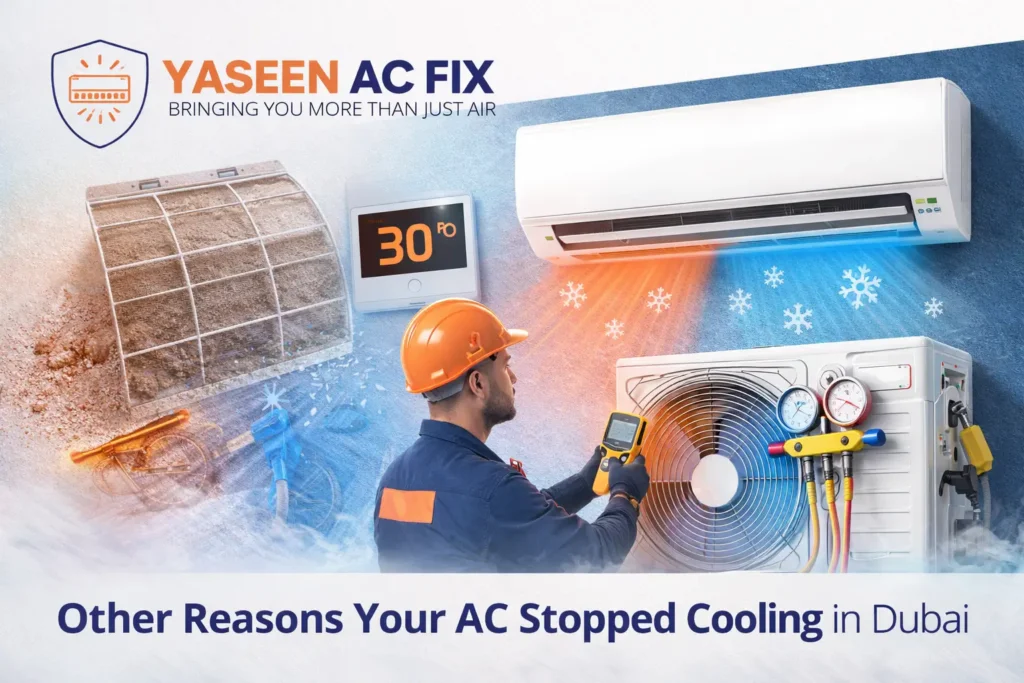
The four issues above account for the majority of AC cooling failures in Dubai. But there are a few other causes worth knowing about, especially if the basic checks and the problems above do not explain what is happening with your unit.
Faulty Thermostat or Wrong Temperature Settings
Before assuming the worst, double-check your thermostat. This sounds obvious, but it is genuinely one of the most common service calls in Dubai: someone has accidentally changed the mode to fan-only, or the target temperature is set higher than the room temperature. The AC runs, the fan blows, but no cooling happens because the system does not think any is needed.
The most energy-efficient temperature for a Dubai home is 24°C. At this setting, the AC cools effectively without over-stressing the system. Each degree below 24°C adds roughly 5 to 8 percent to your electricity consumption and does not cool the room any faster.
Fan Motor Failure: When Air Stops Moving Completely
Your AC has two fans: one inside the indoor unit that circulates room air across the evaporator coil, and one in the outdoor unit that pulls air through the condenser coil to release heat. When either fan motor fails, the system loses its ability to move heat.
In Dubai, fan motors burn out faster due to constant dust buildup in the motor bearings. If your indoor unit is running but you feel little to no air coming from the vents, or if the outdoor unit is silent when the AC is switched on, a failed fan motor is a likely cause.
Blocked Condensate Drain Line and Water Leaking from AC
As your AC cools the room, it also removes moisture from the air. This water drains through a condensate drain line. In Dubai’s humid summer months, this drain line can become blocked with algae, dust, or mold, causing water to back up and flood the drain pan.
When the drain pan overflows, some AC units automatically shut off cooling to prevent water damage. If you see water dripping from your indoor unit or notice a wet patch on the wall below it, a blocked drain line is the likely cause. This is a relatively quick fix for a technician, but it should not be ignored. Standing water in an AC unit creates mold that gets blown directly into your indoor air.
Electrical Issues: Tripped Breakers and DEWA Power Fluctuations
Dubai’s power grid handles an enormous load during summer, with almost every building running air conditioning at full capacity for months. Power fluctuations, brief drops or spikes in supply voltage are more common during peak demand hours. These fluctuations can trip your AC’s circuit breaker as a protective measure, or damage sensitive electronic components in older units.
If your AC stopped working suddenly and there was no gradual decline in performance, check your breaker panel first. A tripped breaker is a five-second fix. If the breaker trips again immediately after you reset it, do not touch it again. That repeated tripping is the breaker protecting your system from a more serious electrical fault. Call a qualified AC technician.
What You Can Fix Yourself vs When to Call an AC Technician in Dubai
Not every cooling problem needs a professional. Some genuinely are simple fixes you can do in five minutes. Others look simple but are not, and attempting them without the right knowledge can make the problem worse or damage the unit. Here is an honest breakdown.
| Safe to Do Yourself | Call a Professional |
| Clean or replace the air filter | Refrigerant leak or recharge |
| Check and adjust thermostat settings | Compressor repair or replacement |
| Reset a tripped circuit breaker (once only) | Evaporator or condenser coil cleaning |
| Clear visible blockage around the outdoor unit | Fan motor replacement |
| Replace thermostat battery | Electrical faults or wiring issues |
| Condensate drain clearing (if water is leaking inside) |
Safe DIY Checks You Can Do Right Now
If your AC stopped cooling, run through this list before calling anyone:
- Set thermostat to Cool mode, target temperature at least 4 degrees below room temperature.
- Check the circuit breaker reset once if tripped. Stop if it trips again.
- Remove and inspect the air filter. Clean it if dusty. Let it dry before replacing.
- Make sure all vents in the room are open and not blocked by furniture or curtains.
- Check that the outdoor unit is not buried in dust or blocked by garden equipment or a parked car. Leave at least 50 cm of clearance on all sides.
Warning Signs That Need a Professional AC Repair in Dubai Immediately
Do not wait and do not attempt these yourself:
- You smell burning or see any smoke from the indoor or outdoor unit.
- The circuit breaker trips a second time immediately after you reset it.
- Water is dripping from the indoor unit onto the floor or wall.
- You hear loud grinding, clanking, or screeching from the outdoor unit.
- The AC stopped cooling completely with no prior warning at all.
- You smell a faint chemical or sweet odor near the unit. This is a refrigerant leak.
In Dubai’s summer, these situations qualify as same-day emergencies. The longer a serious AC problem runs without a fix, the more expensive it tends to become.
How to Stop Your AC from Breaking Down in Dubai’s Summer
The most effective thing you can do for your AC in Dubai is not to fix problems but to prevent them. Most of the reasons an AC stops cooling are predictable and preventable with basic, consistent maintenance.
A Simple AC Maintenance Checklist for Dubai Homeowners
Follow this schedule, and you will significantly reduce the chance of your AC failing during the hottest months:
Every 3 to 4 weeks: Clean the air filter. In dusty periods or near construction zones, do this every 2 to 3 weeks.
Every 3 months: Check that the outdoor unit is clear of dust and debris. Clean the area around it. Make sure nothing is blocking airflow through the condenser fins.
Before summer (April): Book a professional AC service. This should include filter cleaning, coil cleaning (both evaporator and condenser), refrigerant level check, drain line flush, and a full performance test.
After summer (October/November): Book a second professional service to clear the buildup from five months of intense use and prepare the system for the following year.
Why Professional AC Servicing Twice a Year is Non-Negotiable in the UAE
In most countries, once a year is enough for an AC service. In Dubai, it is not. The combination of near-constant operation, extreme temperatures, and heavy dust load means your AC accumulates in six months what a system in a moderate climate accumulates in two or three years.
A twice-yearly professional service from a reliable team like Yaseen AC Fix does not just clean the system; it catches problems before they become breakdowns. A refrigerant level that is slightly low in April becomes a non-cooling AC in July. A condenser coil that is 40 percent blocked in March becomes an overheated compressor failure in August. Catching these things early saves real money and real discomfort.
Book your next AC service at yaseenacfix.com before Dubai’s summer heat peaks.
Conclusion: Get Your AC Cooling Again in Dubai with the Right Fix
When an AC stops cooling in Dubai, the cause is almost always one of five things: a clogged air filter, low refrigerant from a gas leak, dirty evaporator or condenser coils, a failing compressor, or an electrical fault. Start with the simple checks: thermostat, breaker, and filter, and you will often solve it yourself in minutes.
If the simple checks do not restore cooling, do not wait. In Dubai’s summer, a non-functioning AC can become a genuine health risk within hours, particularly for vulnerable family members. A same-day call to a professional is always the right move.
Yaseen AC Fix provides professional AC repair and maintenance services across Dubai and the wider UAE. Our certified technicians diagnose the problem correctly the first time and fix it properly, no guesswork, no repeat visits for the same issue. Book your service at yaseenacfix.com or reach out to us directly. Stay cool.
Frequently Asked Questions About AC Not Cooling in Dubai
1. Why has my AC stopped cooling suddenly in Dubai?
Usually due to a tripped breaker, faulty capacitor, or compressor failure. Reset the breaker once. If the issue continues, call a technician.
2. Why is my AC running but not cooling the room?
Most likely causes: dirty filter, low refrigerant, or dirty coils. Clean the filter first; if there is no improvement, professional service is needed.
3. How do I reset my AC when it stops cooling?
Turn off the AC and breaker for 30 seconds, then restart. If cooling doesn’t improve within 15 minutes, it’s likely a technical issue.
4. Can a dirty filter stop AC cooling completely?
Yes. A clogged filter blocks airflow, causing the coil to freeze and stopping proper cooling.
5. How often should I service my AC in Dubai?
At least twice a year (before and after summer). In dusty areas, consider servicing 3 times annually.
6. Is it normal for AC to stop cooling in Dubai’s heat?
Common, but not normal. It usually indicates issues like dirty coils or low refrigerant that need fixing.
7. What is the best temperature to set the AC in Dubai?
24°C is ideal for comfort and efficiency. Lower settings increase electricity use without faster cooling.